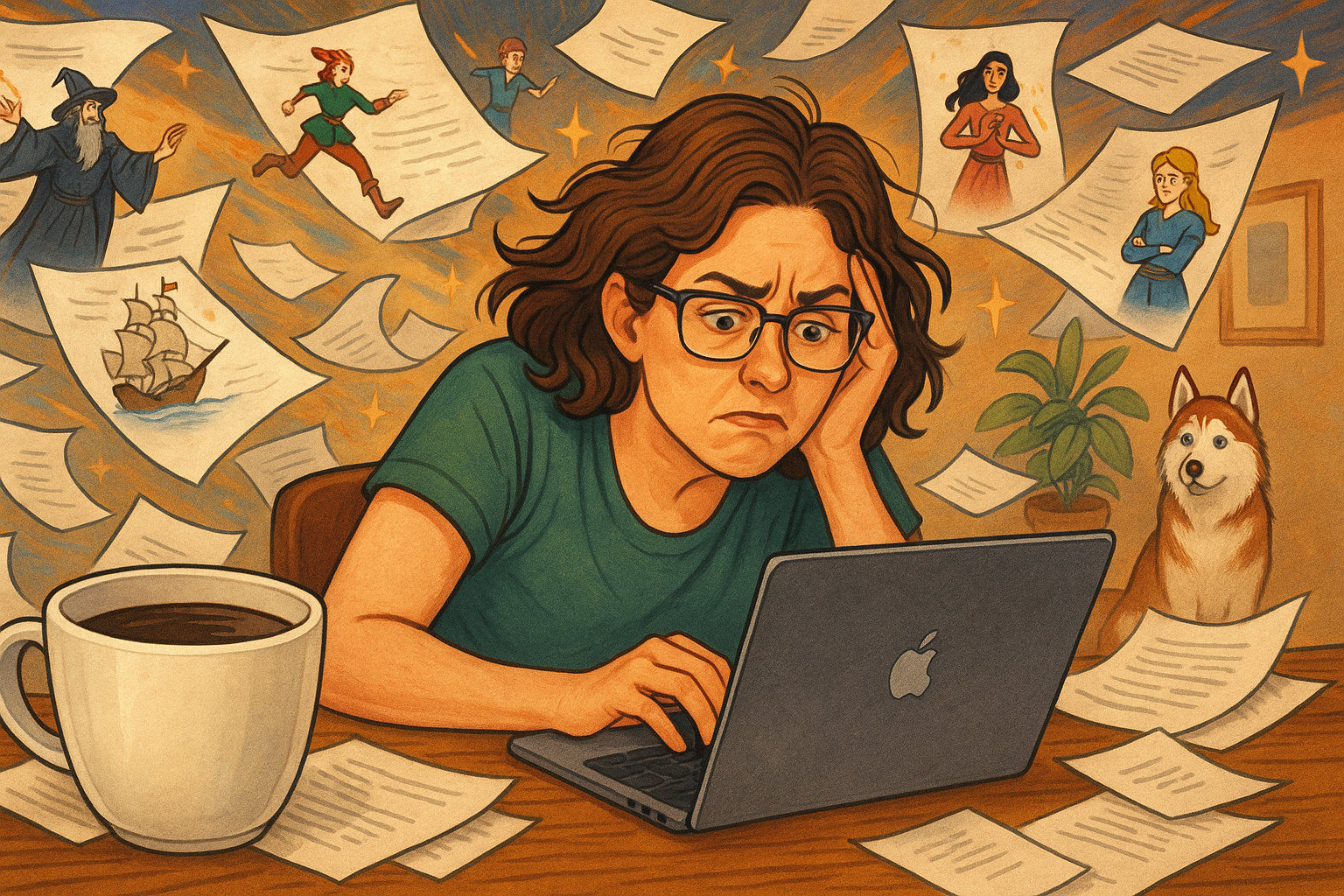
I have three story-children right now, and I’m a terrible mother to all of them.
There’s the eldest (a fantasy trilogy that consumed about a month of my life, during which I listened to an unholy amount of sea chanties), the middle child (a magical realism standalone that got all my attention for almost one whole week), and the youngest (another fantasy trilogy, because apparently I have a type). They’re sitting in various folders in Google Drive, increasingly chaotic Apple Notes documents, some random Markdown files (a holdover from that one week a while back when I was frenetically convinced that I was going to get my life together by shoving everything into Obsidian), and possibly burned so hard into my psyche that I could die 40 years from now and my last words will be to wheeze out the solution to some random plot hole I gave up on. All of them waiting for me to come back and finish raising them properly.
But here’s the thing: I keep making new ones instead.
I realize how this sounds. I realize that admitting to serial creative abandonment while your existing projects slowly starve for attention makes me sound like exactly the kind of writer other writers roll their eyes at. “Oh, another one of those,” they mutter into their coffee, thinking about their own single, carefully nurtured manuscript that they’ve been faithfully tending for three years.
They’re not wrong to judge me. I am absolutely that person.
Let me tell you about my parenting style, because it follows a disturbingly consistent pattern that I’ve only recently started to recognize (and by “recently” I mean “literally while writing this sentence”).
The honeymoon phase: when everything is perfect and I’m the world’s best mom
When I first meet a new story, I’m the most attentive parent imaginable. I shower it with everything: detailed character backstories, intricate world-building, magic systems refined through multiple iterations. I spend hours crafting family trees and political systems and historical timelines stretching back thousands of years. I outline chapters with obsessive care. I research Renaissance shipbuilding techniques and the theoretical physics of steampunk airships because somehow these details feel essential to the story’s DNA.
This is the spoiling phase. My new story-child gets everything: unlimited time, resources, attention. I’ll spend three hours researching the proper terminology for different types of medieval fortifications for one throwaway line. I’ll create detailed maps. I’ll write extensive character questionnaires for people who might never appear on the page.
I’m that mom who documents every single milestone. First outline completed! First chapter drafted! Look how perfectly structured this plot is! Look at these compelling characters with their rich inner lives!
And during this phase, I genuinely believe this is The One. This is the story I’ll finally see through to completion. This is my magnum opus, my breakout novel, the book that will make readers weep and critics swoon and my mother finally understand what I could have done with more encouragement.
I am fucking delusional.
The misbehaving phase: when my characters start having opinions
Here’s where things get uncomfortable, because this is where the parallel to actual parenting becomes less cute and more uncomfortably accurate.
See, stories (like children) eventually develop their own personalities. Characters start making choices I didn’t anticipate. Plot threads tangle in ways I didn’t outline. The magic system I spent weeks perfecting suddenly doesn’t work for the story I’m actually telling. My beautiful, controllable outline starts feeling like a straightjacket.
This is when my story-children start “misbehaving.”
And what do I do when faced with the messy, unpredictable reality of something I created refusing to stay in the neat little box I built for it? When my characters start surprising me and demanding things I didn’t plan for?
I emotionally withdraw. Just like I learned to do as a child when things got hard and there wasn’t enough support to push through.
I stop showing up. I start making excuses. “I just need to think through this plot problem.” “I should probably do more research first.” “Maybe I need to restructure the whole thing.” I develop sudden urgent interests in new projects that seem so much more manageable, so much more exciting.
It’s textbook avoidant attachment, except instead of abandoning actual children, I’m abandoning fictional worlds that exist only in my head. Which somehow makes it both less harmful and more pathetic.
The replacement baby syndrome
You know what I do when one of my story-children starts acting difficult and demanding actual work from me?
I move one state over, commit authorial bigamy, and churn out a new baby.
Not literally (thank the gods), but creatively. Suddenly I’m struck by a brilliant new idea that’s so much more compelling than whatever messy situation I’m trying to avoid. This new story feels fresh and manageable and full of potential. It doesn’t have any of the complicated emotional baggage of that other project. It doesn’t demand that I push through difficult scenes or solve complex plot problems or face the uncomfortable reality that writing a book is actually really fucking hard.
It’s the literary equivalent of that person who starts planning their next relationship while still technically in their current one. Except instead of cheating on humans with feelings, I’m cheating on imaginary people who can’t actually be hurt by my emotional unavailability.
(Which, again: somehow, weirdly, makes it worse, not better.)
My eldest story-child (the fantasy trilogy) is the most neglected. I spent over a month building that world. Literally thousands of years of history. Multiple continents, complex political systems, an intricate magic system I refined through six different iterations. I have character sheets for people who don’t even appear until book three. I wrote twelve chapters, outlined the entire first book chapter by chapter.
And then my characters started surprising me.
The protagonist made a choice I didn’t expect. A side character became more interesting than I’d planned. The magic system that looked so elegant on paper started feeling clunky when I actually tried to write it. The plot wanted to go in directions I hadn’t outlined.
So I… left.
I told myself I just needed some time to think things through. I started a new document to “work out some plot issues.” That document somehow became a completely different story (the magical realism one). Which I threw myself into with the exact same obsessive energy I’d given the fantasy trilogy.
And then, predictably, that one started misbehaving too.
What happens to abandoned story-children
Here’s the thing nobody tells you about creative abandonment: your story-children don’t just disappear when you stop paying attention to them. They don’t quietly fade away or find new parents or become independent. They just… wait.
They sit in their folders like abandoned Tamagotchis, exactly as you left them (dead for the moment, but resurrectable). That fantasy trilogy is still frozen in the middle of chapter twelve, right where my protagonist was about to make a decision I didn’t know how to write. The magical realism novel is stuck three chapters in, right where my metaphor of problem drinking being the result of a literal curse started to get painfully clunky.
And sometimes, late at night when I’m procrastinating on whatever new project has my attention, I’ll open those old files and read what I wrote. And it’s… good? Actually really fucking good in places?
Which makes everything worse.
Because it means I’m not abandoning these projects because they’re bad. I’m abandoning them because finishing them would require me to push through the uncomfortable middle part, the part where writing stops being planning and research and world-building and becomes the messy, difficult work of actually telling a story.
The question I can’t answer
So here’s what I’m wondering, as I sit here with three abandoned story-children and a growing suspicion that I might be some kind of creative sociopath:
Is there a way to channel this emotional promiscuity into something lasting?
Because here’s the weird thing: I think my inability to commit to one project might actually be teaching me something. Each abandoned story has given me skills I didn’t have before. The fantasy trilogy taught me how to build complex political systems. The magical realism novel taught me how to write emotion without sentiment. The newest fantasy project is teaching me how to plot without overthinking.
Maybe I’m not a negligent parent. Maybe I’m more like a serial foster mother, taking in story-children just long enough to give them some essential foundation before passing them on to… who? My future self? Some hypothetical version of me who’s learned how to push through the difficult middle parts?
Or maybe I’m just really good at coming up with elaborate justifications for my own emotional immaturity.
The possibly hopeful ending (or: what I’m trying to do differently this time)
I started a new project last week. (I know, I know.) But this time, I’m trying something different. Instead of building an elaborate world and detailed outline before I start writing, I’m just… writing. Messy first draft, character decisions I haven’t planned for, plot threads I’m discovering as I go.
It feels terrifying and uncomfortable and completely wrong.
It also feels like maybe the only way I’ll ever actually finish anything.
Because maybe the problem isn’t that I’m a negligent parent to my stories. Maybe the problem is that I’m an overprotective parent who can’t handle watching my story-children make their own mistakes and grow up into something messier and more complicated than I planned.
Maybe the trick isn’t to stop creating new stories, but to learn how to let the ones I’ve already created become what they want to become, even if that’s not what I originally envisioned.
Maybe I need to stop trying to control my story-children and start trusting them to surprise me.
Or maybe this is just another elaborate justification for my creative commitment issues, and I’ll abandon this new project the moment it starts demanding actual emotional labor from me.
But hey, at least now I have enough material for a really good essay about why I can’t finish anything.
Which I did finish, so… progress?
Leave a Reply