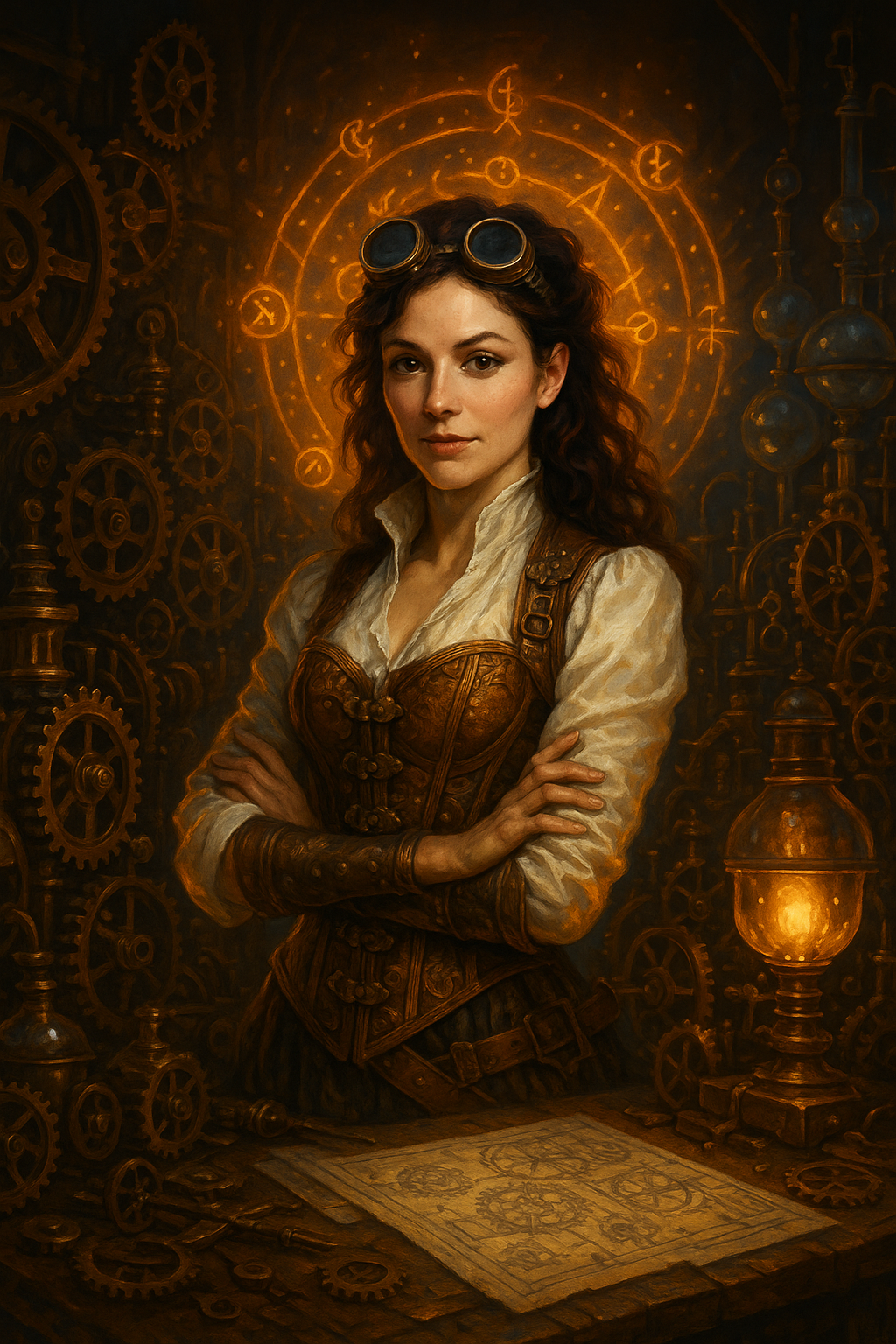
So here’s the thing about procrastination when you’re Olympic-calibre at the sport: it’s got layers. Like an onion, except instead of making you cry, it makes you question every life choice that led you to researching the precise difference between alchemy and actual science in Victorian-era fantasy literature at 2 AM on a Tuesday. Again.
I should probably start at the beginning, which was recently when I was supposed to be making a budget. You know, that thing responsible adults do where they look at numbers and make charts and pretend they have their shit together? Yeah, that. Instead, I found myself opening a new document and typing “Chapter One” at the top of a blank page.
I hadn’t written fiction in over twenty years.
The fantasy trilogy that emerged from my budget-avoidance was ambitious in the way that only complete delusion can be. Three books! Intricate world-building! A magic system so complex I needed spreadsheets! (Which, now that I think about it, might have been a more palatable way to approach budgeting, but hindsight is a bitch.) Twenty thousand words in, I realized I had created something that would require approximately seven additional lifetimes to complete, assuming I could figure out whether my entire book two arc had a point beyond that one scene I kept imagining.
So naturally, I pivoted.
The second project was going to be smarter. Simpler. A standalone magical realism novel that was basically my life story but with, you know, magic. How hard could that be? Turns out, pretty fucking hard when you realize that processing your own trauma through metaphor while simultaneously trying to craft compelling narrative is like performing surgery on yourself while riding a pissed off horse. Uphill. In a thunderstorm.
Which brings us to Project Number Three, aka How I Learned to Stop Worrying and Love the Brass Fittings.
I don’t remember the exact moment I slipped into steampunk territory. It wasn’t dramatic. There was no sudden revelation, no Come to Gears moment. One day I was writing about modern-day magic and the next I was researching the tensile strength of copper tubing and wondering whether airship captains would realistically wear leather or brass bracers. (Leather, obviously. Brass would be too heavy for practical use and the heat conductivity around all that steam is a risk, but you could incorporate brass accents for aesthetic purposes.)
See? This is what I mean about layers.
I’ve become someone who has opinions about the structural integrity of fictional flying machines. I know the difference between gaslamp fantasy and classical steampunk (it’s all about the magic-to-science ratio, if you’re curious). I own a belt with a drop holster style pouch that I’ve now realized is perfectly suited for carrying mysterious vials and clockwork devices, though it currently holds dog treats and some very unstylish hand sanitizer.
Here’s the beautiful absurdity of it all: I used to roll my eyes at steampunk. Not in a mean way, just in that gentle, bemused way you might regard someone’s particularly niche hobby. Like people who collect vintage thimbles or know way too much about train schedules from the 1890s. It seemed so… specific. So committed to an aesthetic that required goggles you’d never actually use outfits that work with a bustle.
And yet.
There’s something about the brass and leather and impossible machinery that speaks to a part of my brain I’d forgotten existed. Maybe it’s because I spent years studying the history and philosophy of science, diving deep into what it meant to live in an era when the boundaries between science and magic were blurrier, when invention felt like incantation. Or maybe I’m just contrary enough to be drawn to the one fantasy subgenre that isn’t just medieval Europe, but with dragons.
Or maybe, and this is the theory I’m going with, I just really like goggles.
A fan of my long-defunct blog once sent me a pair, years ago. At the time, I thought it was sweet but puzzling. Now I’m wondering if they saw something I didn’t. Some latent steampunk potential lurking beneath my surface, waiting for the right combination of procrastination and creative desperation to emerge.
The story I’m working on now draws loose inspiration from the Irish goddess The Morrigan, particularly her aspect as a sovereignty goddess. It’s the same old story we’ve been telling as a species for millennia: rebellion against tyranny, the fight for autonomy, the refusal to bow to systems that crush the human spirit. Because genuinely, fuck fascism. Even fictional fascism with really excellent costume design.
But here’s what I’m learning about creativity after two decades of… what? Drought? Hibernation? Traumatic dormancy? I honestly can’t remember what it felt like before. Childhood memories are sparse at best, a side effect of growing up with well-meaning parents who did a genuinely godawful job in ways that scrambled my neural pathways and left me questioning whether I was worth taking up space in the world.
But I remember that creativity used to feel easy. Natural. Like I was born with stories in my heart and an innate knowledge of how to assemble words not just to share information, but to evoke feelings. To make people feel less alone in their own beautiful, messy humanity.
This current chaos feels different. It’s messier, more chaotic, like my brain is a construction site where creativity is rebuilding itself from the ground up while I’m still trying to live in it. Every project feels like controlled demolition followed by frantic rebuilding. I’m an ADHD fractal, generating increasingly complex patterns of creative avoidance that somehow, miraculously, lead to actual creation.
The Bluetooth keyboard that looks like an 18th-century typewriter hasn’t arrived yet, but when it does, my workspace will be complete. Or at least more aesthetically aligned with my current obsession. I can already imagine the satisfying click of brass-colored keys as I type about airship rebellions and clockwork hearts and the precise alchemical formula for revolution.
Because that’s what this all is, really. Revolution. Not just in the story I’m telling, but in the very act of telling it. Every word I write is a small act of rebellion against the voice that spent decades telling me I wasn’t creative, wasn’t interesting, wasn’t worth listening to. Every ridiculous plot twist involving steam-powered machinery and gaslight magic transmission is a middle finger to the trauma responses that convinced me my imagination was broken beyond repair.
I’m probably going to make dozens of terrible, half-finished messes. I might never create anything worth showing the world. But you know what? The process of creating feels amazing. It feels like coming home to a part of myself I thought was lost forever, except this version comes with better fashion sense and strong opinions about the practical applications of pneumatic tube systems.
There’s something deeply satisfying about the steampunk aesthetic that I’m only now beginning to understand. It’s not just the brass and gears and goggles (though the goggles are undeniably excellent). It’s the idea that you can take the machinery of the past and reimagine it into something that never existed but absolutely should have. It’s retrofuturism for people who believe the future can be more beautiful and just more than what we’ve been handed.
In gaslamp fantasy specifically, there’s this perfect balance between the magical and the mechanical, where alchemy and engineering dance together in ways that make scientific sense if you don’t think too hard about it. It’s fantasy for people who want their magic systems to have blueprints, their rebellions to have mystical tech, their heroes to wear practical boots that can also look amazing with, gods help me, a top hat.
And if that’s not a metaphor for rebuilding your creative life after trauma, I don’t know what is.
I’ve started thinking about creativity differently now. Not as something I either have or don’t have, but as something I can rebuild. Like a particularly ambitious automaton, it requires the right materials, careful engineering, and a willingness to believe that something that’s never existed before might actually be able to function.
Some days the whole project feels ridiculous. I’m a middle-aged woman writing about fictional rebellions involving impossible technology while avoiding real-world responsibilities like addressing my sorry finances and having my life together in other conventional ways. But then I remember that the alternative is not writing at all, not creating, not allowing that part of myself to exist in the world.
And that feels like the worst kind of tyranny.
So I’ll keep writing about tripartite goddesses and steam-powered revolutions. I’ll research the metallurgy of fictional machinery and debate the practical implications of corsetry in combat situations (despite firsthand knowledge that they simply fuck up your shit in a proper brawl). I’ll probably start more projects than I finish, pivot more than a dancer being electrocuted, and continue to be the kind of person who has strong opinions about “what if?” technology.
Because this is what creativity looks like for me now: not a smooth, linear process, but a beautiful, chaotic spiral that somehow keeps moving forward even when it seems to be going in circles. A sloppy, perfect pattern of procrastination and passion, avoidance and engagement, that generates something new with every iteration.
And if that something happens to involve goggles and leather dusters and protagonists who refuse to bow to regimes (fictional or otherwise), well… that seems exactly right for where I am in my life right now.
The typewriter keyboard should arrive next week.
I can hardly wait to see what impossible thing I’ll build with it, or what weird new obsession has arrived before it does.

Leave a Reply