Word Salad

  • Excavating Myself at Forty-Something

    Excavating Myself at Forty-Something

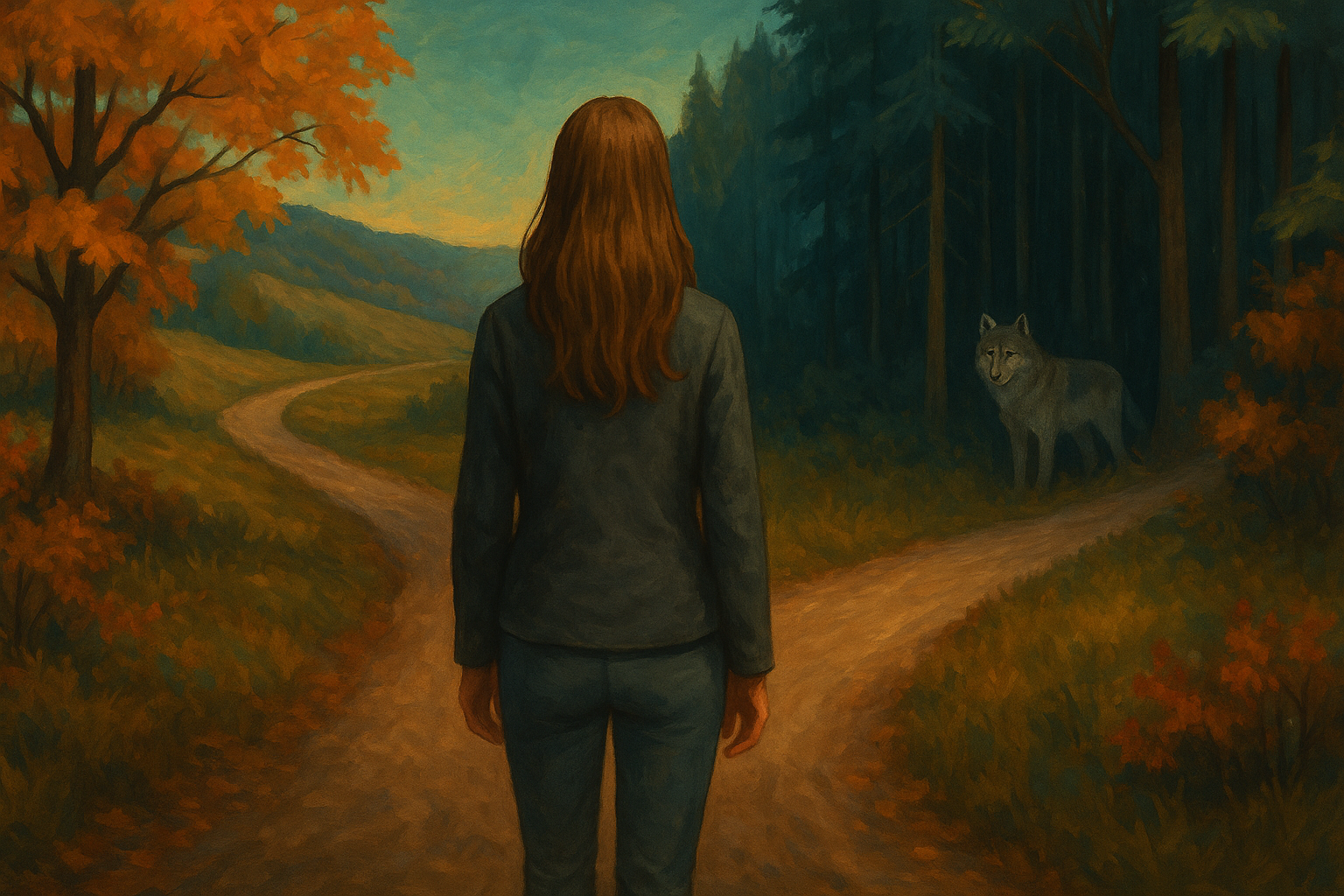
    I found myself standing in the middle of the grocery store on a Monday morning, staring at a pathetically empty basket containing exactly three items: a near lunatic amount of vanilla Greek yogurt, a slab of firm tofu, and a sad little succulent plant I didn’t need but somehow felt would understand me. This, apparently, is what freedom looks like at forty-something. Not the dramatic Eat-Pray-Love spiritual awakening I’d been subconsciously promised, but instead the quiet panic of realizing I don’t actually know what food I like when there’s no one else making meals for me or to consider with my own menu choices.

    Let me back up.

    After five years of that special relationship purgatory where you’re technically together but your journal reads like a hostage diary, I finally ended things with a man who was simultaneously the most comfortable and uncomfortable presence in my life. It wasn’t dramatic. No plates thrown, no screaming matches worthy of reality TV. Just the slow, crushing realization that I’d been writing the same complaints for years, literally YEARS, and nothing was changing except the date on the page.

    We didn’t live together. That was deliberate, my one act of self-preservation in an otherwise self-destructive pattern. Though he managed to be at my place so much that my bathroom never felt like my own. There’s something uniquely humiliating about dancing from foot to foot outside your own bathroom door while someone takes their sweet time scrolling through Facebook while pooping. Relationship milestones they don’t warn you about.

    It’s been a week and a half now. Today’s his birthday, and I’m noticing how the initial euphoria of “holy shit I can use my sunrise alarm clock without somebody complaining” is giving way to something more complicated. Not regret, exactly, but a quiet that’s so loud it sometimes makes me turn on music just to drown it out.

    The truth about how I got here isn’t particularly original or inspiring. It’s embarrassing and sad and it fits into one word: alcohol. For at least a decade, I’ve been numbing myself one glass (or bottle) at a time, using wine like a fast-forward button on moments I didn’t want to be present for. Which, it turns out, were most of them. Funny how you can spend ten years trying to blur time, only to suddenly look up and wonder where the fuck it all went.

    My apartment is slowly becoming mine again in small ways that feel both triumphant and pathetic. I’ve moved the air fryer to a permanent spot on the counter. No one’s here to complain about it being in their way anymore. I bought a new shower curtain with a ridiculous pattern just because I could. I sleep diagonally across the bed some nights, reclaiming the space.

    I’ve noticed I’m wearing almost exclusively grey now. Like I’m some kind of walking metaphor for the neutral space between a sad relationship and whatever comes next. My closet looks like a black and white movie about a depressed actuary. Sometimes I catch my reflection and don’t recognize the person staring back. Who is she? What does she want? Why can’t she seem to buy clothes in any actual colours?

    The funny thing about ending a long-term relationship in middle age is that you’re suddenly confronted with how much of yourself you’ve lost track of. I used to know exactly who I was. I had opinions about music and books and politics. I had hobbies that didn’t include watching someone else watch right-wing YouTube videos on their phone or listening to explanations of things I didn’t ask to have explained. Now I’m like an archaeological dig of my former self, brushing away the dust and saying “oh right, I used to love morning yoga” or “damn, I actually hate watching the evening news, don’t I?”

    There are moments of absurd joy in this new solitude. I’ve been singing at the top of my lungs at all hours, belting out songs I’d forgotten I loved. My neighbors probably think I’ve lost my mind, which isn’t entirely incorrect. Yesterday I realized I was dancing while making coffee, taking up the space no longer occupied by somebody about to complain I was delaying their morning routine.

    The hardest part (besides the sudden need to catch and release all my own spiders) is the lack of witnesses. I don’t have many close friends — something that made leaving so much harder. When you’re alone, who confirms that you exist? Who laughs at your witticisms, or reminds you of that funny thing that happened three years ago that became an inside joke? The echo chamber of an empty apartment can get pretty loud some evenings.

    But then there are these small victories. I’ve gone grocery shopping two weeks in a row now (unprecedented). I’m learning how to cook simple meals for one person (all hail the mighty air fryer, savior of the lazy novice chef). I’ve started reading books before bed instead of staring at my phone until my eyes burn. These are tiny revolutions, barely visible from the outside, but they feel like momentum building up.

    Sometimes I miss him. Not all of him, and not all the time, but parts. The way he’d look at me from across a room and smile like I was the only person who mattered. How he could make me laugh even when I was determined to stay angry. These memories arrive unexpectedly, like guests who don’t know the party ended. I acknowledge them, offer them a snack, and then politely show them the door.

    The truth is, being alone is better than being in a relationship that makes you lonely. But only by a margin that sometimes feels too slim for comfort. There are nights when I wonder if I’ve made a terrible mistake, if I’ve thrown away something imperfect but real for some fantasy of freedom that doesn’t actually exist. And then morning comes, and I make coffee exactly the way I like it, and remember that this fragile peace is mine. All mine.

    I have no idea what comes next. Dating apps feel like a foreign country where I don’t speak the language. Career ambitions I neglected have atrophied like unused muscles. Some days I feel ancient, looking at twenty-somethings with their apparent confidence and direction. Other days I feel strangely new, like I’m being born again at forty-something, all raw skin and uncertainty and possibility. A reborn foal on wobbly legs (sometimes quite literally, thanks to my newly consistent running schedule).

    Maybe that’s the point. Maybe there is no graceful way to start over. Maybe it’s always going to be messy and confusing and occasionally embarrassing. Maybe the best we can hope for is to be brave enough to stand in the middle of the grocery store with our three random items, not knowing what we’re doing or where we’re going, but showing up anyway.

    At least now I can take as long as I want in the bathroom. Or listen to Golden from K-Pop Demon Hunters on repeat for hours.

  • My Writing Style is ‘Negligent Parent’

    My Writing Style is ‘Negligent Parent’

    I have three story-children right now, and I’m a terrible mother to all of them.

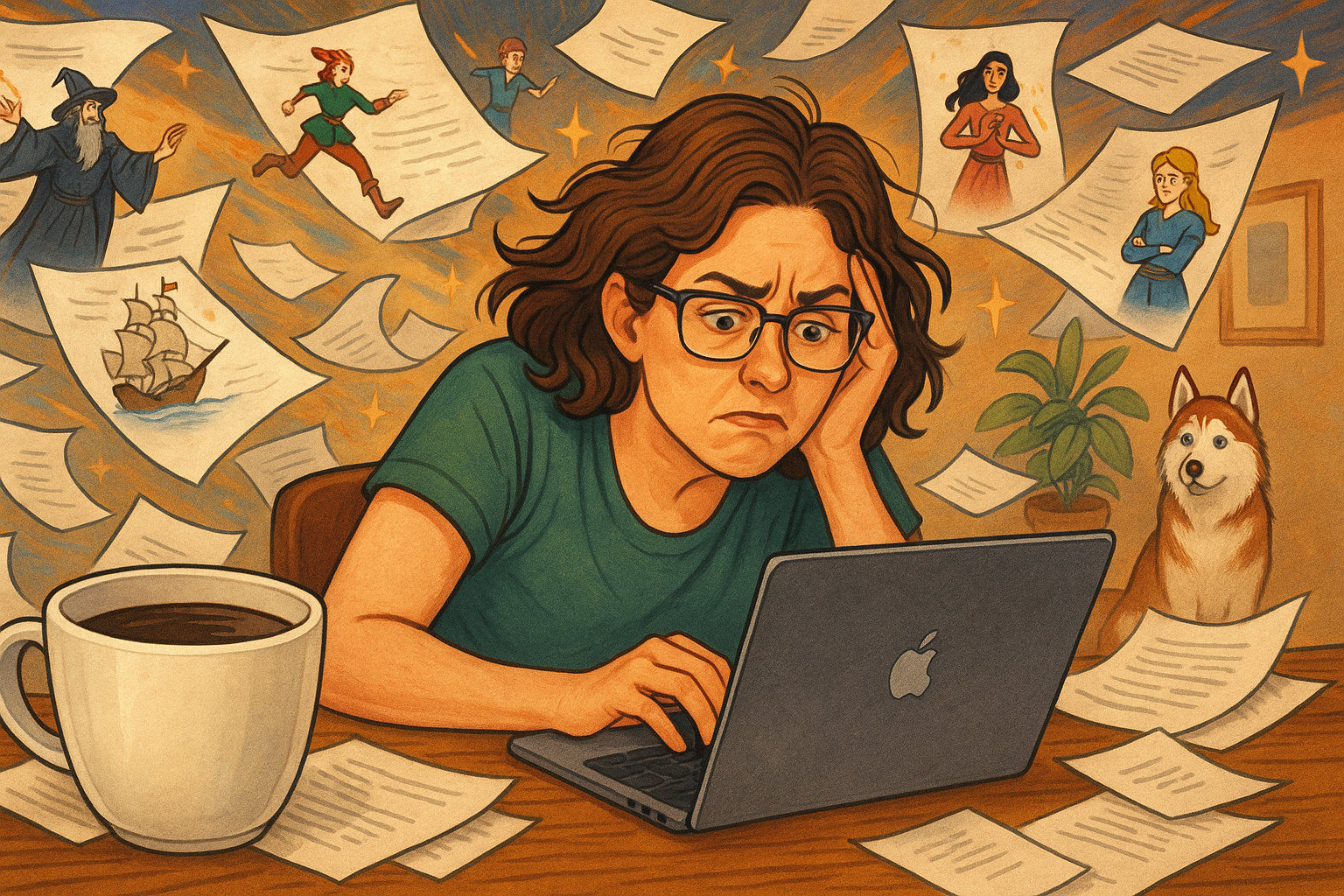
    There’s the eldest (a fantasy trilogy that consumed about a month of my life, during which I listened to an unholy amount of sea chanties), the middle child (a magical realism standalone that got all my attention for almost one whole week), and the youngest (another fantasy trilogy, because apparently I have a type). They’re sitting in various folders in Google Drive, increasingly chaotic Apple Notes documents, some random Markdown files (a holdover from that one week a while back when I was frenetically convinced that I was going to get my life together by shoving everything into Obsidian), and possibly burned so hard into my psyche that I could die 40 years from now and my last words will be to wheeze out the solution to some random plot hole I gave up on. All of them waiting for me to come back and finish raising them properly.

    But here’s the thing: I keep making new ones instead.

    I realize how this sounds. I realize that admitting to serial creative abandonment while your existing projects slowly starve for attention makes me sound like exactly the kind of writer other writers roll their eyes at. “Oh, another one of those,” they mutter into their coffee, thinking about their own single, carefully nurtured manuscript that they’ve been faithfully tending for three years.

    They’re not wrong to judge me. I am absolutely that person.

    Let me tell you about my parenting style, because it follows a disturbingly consistent pattern that I’ve only recently started to recognize (and by “recently” I mean “literally while writing this sentence”).

    The honeymoon phase: when everything is perfect and I’m the world’s best mom

    When I first meet a new story, I’m the most attentive parent imaginable. I shower it with everything: detailed character backstories, intricate world-building, magic systems refined through multiple iterations. I spend hours crafting family trees and political systems and historical timelines stretching back thousands of years. I outline chapters with obsessive care. I research Renaissance shipbuilding techniques and the theoretical physics of steampunk airships because somehow these details feel essential to the story’s DNA.

    This is the spoiling phase. My new story-child gets everything: unlimited time, resources, attention. I’ll spend three hours researching the proper terminology for different types of medieval fortifications for one throwaway line. I’ll create detailed maps. I’ll write extensive character questionnaires for people who might never appear on the page.

    I’m that mom who documents every single milestone. First outline completed! First chapter drafted! Look how perfectly structured this plot is! Look at these compelling characters with their rich inner lives!

    And during this phase, I genuinely believe this is The One. This is the story I’ll finally see through to completion. This is my magnum opus, my breakout novel, the book that will make readers weep and critics swoon and my mother finally understand what I could have done with more encouragement.

    I am fucking delusional.

    The misbehaving phase: when my characters start having opinions

    Here’s where things get uncomfortable, because this is where the parallel to actual parenting becomes less cute and more uncomfortably accurate.

    See, stories (like children) eventually develop their own personalities. Characters start making choices I didn’t anticipate. Plot threads tangle in ways I didn’t outline. The magic system I spent weeks perfecting suddenly doesn’t work for the story I’m actually telling. My beautiful, controllable outline starts feeling like a straightjacket.

    This is when my story-children start “misbehaving.”

    And what do I do when faced with the messy, unpredictable reality of something I created refusing to stay in the neat little box I built for it? When my characters start surprising me and demanding things I didn’t plan for?

    I emotionally withdraw. Just like I learned to do as a child when things got hard and there wasn’t enough support to push through.

    I stop showing up. I start making excuses. “I just need to think through this plot problem.” “I should probably do more research first.” “Maybe I need to restructure the whole thing.” I develop sudden urgent interests in new projects that seem so much more manageable, so much more exciting.

    It’s textbook avoidant attachment, except instead of abandoning actual children, I’m abandoning fictional worlds that exist only in my head. Which somehow makes it both less harmful and more pathetic.

    The replacement baby syndrome

    You know what I do when one of my story-children starts acting difficult and demanding actual work from me?

    I move one state over, commit authorial bigamy, and churn out a new baby.

    Not literally (thank the gods), but creatively. Suddenly I’m struck by a brilliant new idea that’s so much more compelling than whatever messy situation I’m trying to avoid. This new story feels fresh and manageable and full of potential. It doesn’t have any of the complicated emotional baggage of that other project. It doesn’t demand that I push through difficult scenes or solve complex plot problems or face the uncomfortable reality that writing a book is actually really fucking hard.

    It’s the literary equivalent of that person who starts planning their next relationship while still technically in their current one. Except instead of cheating on humans with feelings, I’m cheating on imaginary people who can’t actually be hurt by my emotional unavailability.

    (Which, again: somehow, weirdly, makes it worse, not better.)

    My eldest story-child (the fantasy trilogy) is the most neglected. I spent over a month building that world. Literally thousands of years of history. Multiple continents, complex political systems, an intricate magic system I refined through six different iterations. I have character sheets for people who don’t even appear until book three. I wrote twelve chapters, outlined the entire first book chapter by chapter.

    And then my characters started surprising me.

    The protagonist made a choice I didn’t expect. A side character became more interesting than I’d planned. The magic system that looked so elegant on paper started feeling clunky when I actually tried to write it. The plot wanted to go in directions I hadn’t outlined.

    So I… left.

    I told myself I just needed some time to think things through. I started a new document to “work out some plot issues.” That document somehow became a completely different story (the magical realism one). Which I threw myself into with the exact same obsessive energy I’d given the fantasy trilogy.

    And then, predictably, that one started misbehaving too.

    What happens to abandoned story-children

    Here’s the thing nobody tells you about creative abandonment: your story-children don’t just disappear when you stop paying attention to them. They don’t quietly fade away or find new parents or become independent. They just… wait.

    They sit in their folders like abandoned Tamagotchis, exactly as you left them (dead for the moment, but resurrectable). That fantasy trilogy is still frozen in the middle of chapter twelve, right where my protagonist was about to make a decision I didn’t know how to write. The magical realism novel is stuck three chapters in, right where my metaphor of problem drinking being the result of a literal curse started to get painfully clunky.

    And sometimes, late at night when I’m procrastinating on whatever new project has my attention, I’ll open those old files and read what I wrote. And it’s… good? Actually really fucking good in places?

    Which makes everything worse.

    Because it means I’m not abandoning these projects because they’re bad. I’m abandoning them because finishing them would require me to push through the uncomfortable middle part, the part where writing stops being planning and research and world-building and becomes the messy, difficult work of actually telling a story.

    The question I can’t answer

    So here’s what I’m wondering, as I sit here with three abandoned story-children and a growing suspicion that I might be some kind of creative sociopath:

    Is there a way to channel this emotional promiscuity into something lasting?

    Because here’s the weird thing: I think my inability to commit to one project might actually be teaching me something. Each abandoned story has given me skills I didn’t have before. The fantasy trilogy taught me how to build complex political systems. The magical realism novel taught me how to write emotion without sentiment. The newest fantasy project is teaching me how to plot without overthinking.

    Maybe I’m not a negligent parent. Maybe I’m more like a serial foster mother, taking in story-children just long enough to give them some essential foundation before passing them on to… who? My future self? Some hypothetical version of me who’s learned how to push through the difficult middle parts?

    Or maybe I’m just really good at coming up with elaborate justifications for my own emotional immaturity.

    The possibly hopeful ending (or: what I’m trying to do differently this time)

    I started a new project last week. (I know, I know.) But this time, I’m trying something different. Instead of building an elaborate world and detailed outline before I start writing, I’m just… writing. Messy first draft, character decisions I haven’t planned for, plot threads I’m discovering as I go.

    It feels terrifying and uncomfortable and completely wrong.

    It also feels like maybe the only way I’ll ever actually finish anything.

    Because maybe the problem isn’t that I’m a negligent parent to my stories. Maybe the problem is that I’m an overprotective parent who can’t handle watching my story-children make their own mistakes and grow up into something messier and more complicated than I planned.

    Maybe the trick isn’t to stop creating new stories, but to learn how to let the ones I’ve already created become what they want to become, even if that’s not what I originally envisioned.

    Maybe I need to stop trying to control my story-children and start trusting them to surprise me.

    Or maybe this is just another elaborate justification for my creative commitment issues, and I’ll abandon this new project the moment it starts demanding actual emotional labor from me.

    But hey, at least now I have enough material for a really good essay about why I can’t finish anything.

    Which I did finish, so… progress?

  • Goggles: A Love Story

    Goggles: A Love Story

    So here’s the thing about procrastination when you’re Olympic-calibre at the sport: it’s got layers. Like an onion, except instead of making you cry, it makes you question every life choice that led you to researching the precise difference between alchemy and actual science in Victorian-era fantasy literature at 2 AM on a Tuesday. Again.

    I should probably start at the beginning, which was recently when I was supposed to be making a budget. You know, that thing responsible adults do where they look at numbers and make charts and pretend they have their shit together? Yeah, that. Instead, I found myself opening a new document and typing “Chapter One” at the top of a blank page.

    I hadn’t written fiction in over twenty years. 

    The fantasy trilogy that emerged from my budget-avoidance was ambitious in the way that only complete delusion can be. Three books! Intricate world-building! A magic system so complex I needed spreadsheets! (Which, now that I think about it, might have been a more palatable way to approach budgeting, but hindsight is a bitch.) Twenty thousand words in, I realized I had created something that would require approximately seven additional lifetimes to complete, assuming I could figure out whether my entire book two arc had a point beyond that one scene I kept imagining.

    So naturally, I pivoted.

    The second project was going to be smarter. Simpler. A standalone magical realism novel that was basically my life story but with, you know, magic. How hard could that be? Turns out, pretty fucking hard when you realize that processing your own trauma through metaphor while simultaneously trying to craft compelling narrative is like performing surgery on yourself while riding a pissed off horse. Uphill. In a thunderstorm.

    Which brings us to Project Number Three, aka How I Learned to Stop Worrying and Love the Brass Fittings.

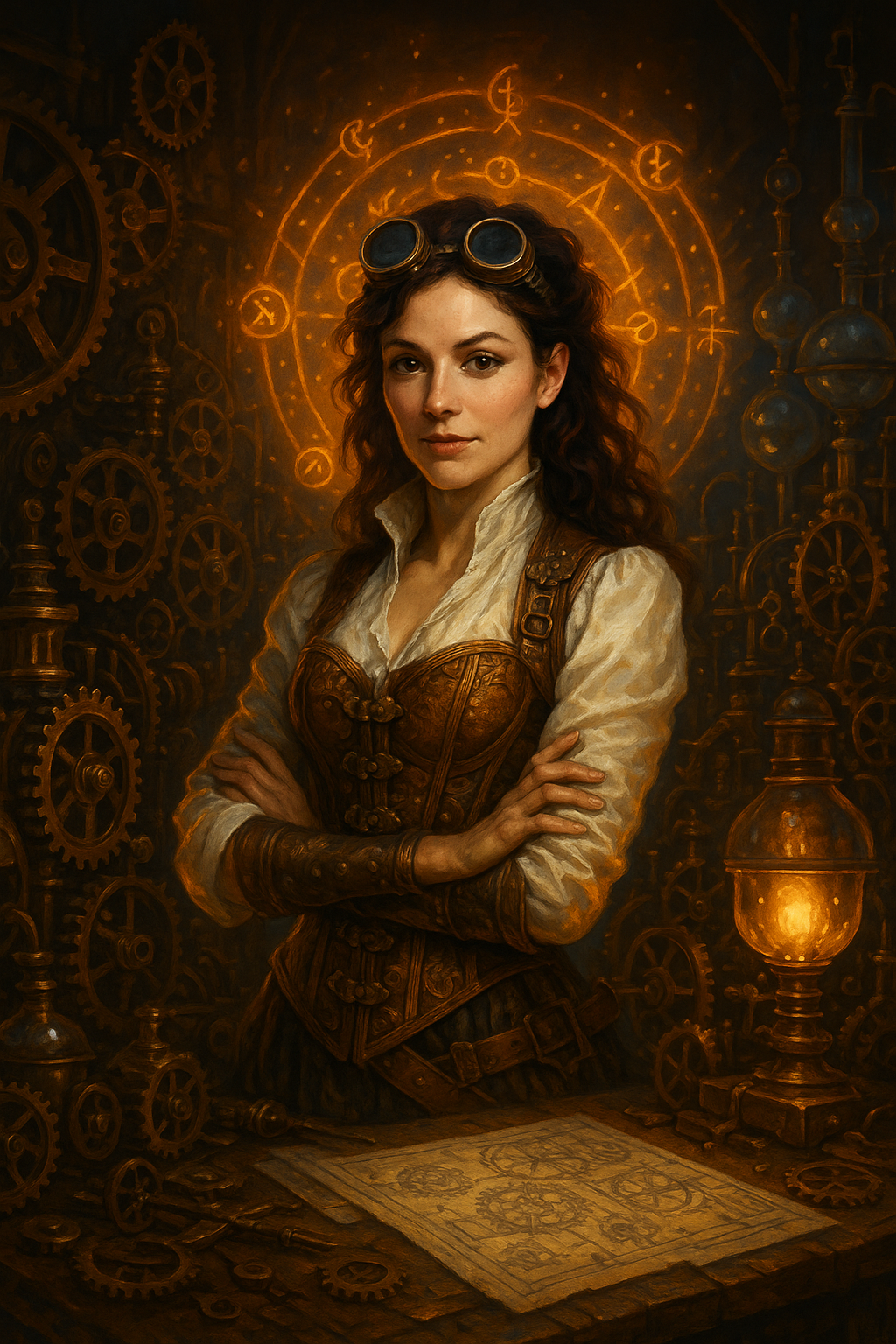
    I don’t remember the exact moment I slipped into steampunk territory. It wasn’t dramatic. There was no sudden revelation, no Come to Gears moment. One day I was writing about modern-day magic and the next I was researching the tensile strength of copper tubing and wondering whether airship captains would realistically wear leather or brass bracers. (Leather, obviously. Brass would be too heavy for practical use and the heat conductivity around all that steam is a risk, but you could incorporate brass accents for aesthetic purposes.)

    See? This is what I mean about layers.

    I’ve become someone who has opinions about the structural integrity of fictional flying machines. I know the difference between gaslamp fantasy and classical steampunk (it’s all about the magic-to-science ratio, if you’re curious). I own a belt with a drop holster style pouch that I’ve now realized is perfectly suited for carrying mysterious vials and clockwork devices, though it currently holds dog treats and some very unstylish hand sanitizer.

    Here’s the beautiful absurdity of it all: I used to roll my eyes at steampunk. Not in a mean way, just in that gentle, bemused way you might regard someone’s particularly niche hobby. Like people who collect vintage thimbles or know way too much about train schedules from the 1890s. It seemed so… specific. So committed to an aesthetic that required goggles you’d never actually use outfits that work with a bustle.

    And yet.

    There’s something about the brass and leather and impossible machinery that speaks to a part of my brain I’d forgotten existed. Maybe it’s because I spent years studying the history and philosophy of science, diving deep into what it meant to live in an era when the boundaries between science and magic were blurrier, when invention felt like incantation. Or maybe I’m just contrary enough to be drawn to the one fantasy subgenre that isn’t just medieval Europe, but with dragons.

    Or maybe, and this is the theory I’m going with, I just really like goggles.

    A fan of my long-defunct blog once sent me a pair, years ago. At the time, I thought it was sweet but puzzling. Now I’m wondering if they saw something I didn’t. Some latent steampunk potential lurking beneath my surface, waiting for the right combination of procrastination and creative desperation to emerge.

    The story I’m working on now draws loose inspiration from the Irish goddess The Morrigan, particularly her aspect as a sovereignty goddess. It’s the same old story we’ve been telling as a species for millennia: rebellion against tyranny, the fight for autonomy, the refusal to bow to systems that crush the human spirit. Because genuinely, fuck fascism. Even fictional fascism with really excellent costume design.

    But here’s what I’m learning about creativity after two decades of… what? Drought? Hibernation? Traumatic dormancy? I honestly can’t remember what it felt like before. Childhood memories are sparse at best, a side effect of growing up with well-meaning parents who did a genuinely godawful job in ways that scrambled my neural pathways and left me questioning whether I was worth taking up space in the world.

    But I remember that creativity used to feel easy. Natural. Like I was born with stories in my heart and an innate knowledge of how to assemble words not just to share information, but to evoke feelings. To make people feel less alone in their own beautiful, messy humanity.

    This current chaos feels different. It’s messier, more chaotic, like my brain is a construction site where creativity is rebuilding itself from the ground up while I’m still trying to live in it. Every project feels like controlled demolition followed by frantic rebuilding. I’m an ADHD fractal, generating increasingly complex patterns of creative avoidance that somehow, miraculously, lead to actual creation.

    The Bluetooth keyboard that looks like an 18th-century typewriter hasn’t arrived yet, but when it does, my workspace will be complete. Or at least more aesthetically aligned with my current obsession. I can already imagine the satisfying click of brass-colored keys as I type about airship rebellions and clockwork hearts and the precise alchemical formula for revolution.

    Because that’s what this all is, really. Revolution. Not just in the story I’m telling, but in the very act of telling it. Every word I write is a small act of rebellion against the voice that spent decades telling me I wasn’t creative, wasn’t interesting, wasn’t worth listening to. Every ridiculous plot twist involving steam-powered machinery and gaslight magic transmission is a middle finger to the trauma responses that convinced me my imagination was broken beyond repair.

    I’m probably going to make dozens of terrible, half-finished messes. I might never create anything worth showing the world. But you know what? The process of creating feels amazing. It feels like coming home to a part of myself I thought was lost forever, except this version comes with better fashion sense and strong opinions about the practical applications of pneumatic tube systems.

    There’s something deeply satisfying about the steampunk aesthetic that I’m only now beginning to understand. It’s not just the brass and gears and goggles (though the goggles are undeniably excellent). It’s the idea that you can take the machinery of the past and reimagine it into something that never existed but absolutely should have. It’s retrofuturism for people who believe the future can be more beautiful and just more  than what we’ve been handed.

    In gaslamp fantasy specifically, there’s this perfect balance between the magical and the mechanical, where alchemy and engineering dance together in ways that make scientific sense if you don’t think too hard about it. It’s fantasy for people who want their magic systems to have blueprints, their rebellions to have mystical tech, their heroes to wear practical boots that can also look amazing with, gods help me, a top hat. 

    And if that’s not a metaphor for rebuilding your creative life after trauma, I don’t know what is.

    I’ve started thinking about creativity differently now. Not as something I either have or don’t have, but as something I can rebuild. Like a particularly ambitious automaton, it requires the right materials, careful engineering, and a willingness to believe that something that’s never existed before might actually be able to function.

    Some days the whole project feels ridiculous. I’m a middle-aged woman writing about fictional rebellions involving impossible technology while avoiding real-world responsibilities like addressing my sorry finances and having my life together in other conventional ways. But then I remember that the alternative is not writing at all, not creating, not allowing that part of myself to exist in the world.

    And that feels like the worst kind of tyranny.

    So I’ll keep writing about tripartite goddesses and steam-powered revolutions. I’ll research the metallurgy of fictional machinery and debate the practical implications of corsetry in combat situations (despite firsthand knowledge that they simply fuck up your shit in a proper brawl). I’ll probably start more projects than I finish, pivot more than a dancer being electrocuted, and continue to be the kind of person who has strong opinions about “what if?” technology.

    Because this is what creativity looks like for me now: not a smooth, linear process, but a beautiful, chaotic spiral that somehow keeps moving forward even when it seems to be going in circles. A sloppy, perfect pattern of procrastination and passion, avoidance and engagement, that generates something new with every iteration.

    And if that something happens to involve goggles and leather dusters and protagonists who refuse to bow to  regimes (fictional or otherwise), well… that seems exactly right for where I am in my life right now.

    The typewriter keyboard should arrive next week.

    I can hardly wait to see what impossible thing I’ll build with it, or what weird new obsession has arrived before it does. 

  • Learning to Write at a Gallop

    Learning to Write at a Gallop

    I’m starting to think my imaginary world might actually need to exist outside my head. Like, in actual words. On actual pages. That other people might someday read.

    Fuck.

    So I’ve written just over 20,000 words of my current draft. Twenty thousand. A small novella’s worth of words about people who don’t exist doing things that never happened in a world I made up. My original twelve chapters? Tossed into the digital void. Gone. And good riddance, honestly. Now I’m hard stuck at introducing my two main characters, sitting astride my metaphorical horse at the starting line, just waiting for the beast beneath me to bolt and off we’ll go again. Just… waiting. Staring at the blinking cursor. Wondering why the hell I thought I could do this in the first place.

    “Just let loose and write,” my trusted friend (the only one I’ve shared drafts with) told me when I finally confessed my paralysis. “Make a mess. See what’s wrong, broken, nonsensical and then loop back to fix it.”

    Sure. Just let loose. As if it were that simple to silence the endless stream of criticism flowing through my brain every time I put words on a page. As if I could just turn off the part of me that sees every repetition, every clunky transition, every moment where the perfect word hovers just beyond my grasp but I’m too afraid to stop and search for it because what if I never start again?

    The two main characters are there, hovering just on the edge of becoming real people. I can almost hear their voices. I can almost see how they move through the world. But translating them from abstract concepts in my mind to actual flesh-and-blood people on the page feels like trying to catch smoke with my bare hands. I think, maybe, I’m afraid of them. Afraid that once they’re fully realized, they’ll take the story places I didn’t plan for. Or worse, that they’ll remain flat, dull, uninteresting—the literary equivalent of cardboard cutouts propped up against my carefully constructed world.

    But here’s the thing about writing: it’s a lot like riding a horse.

    And I would know, because I’m an enthusiastic citygirl equestrian who has spent enough time in the saddle to understand that both writing and riding require you to balance control with surrender in ways that feel completely unnatural at first.

    When you’re learning to ride, you start at a walk. Everything is manageable. You have time to think about your posture, your hands, your heels. Then comes the trot, and suddenly everything is bumpy and jarring. Your body gets tossed around. You focus intensely on maintaining proper form while being shaken like a martini. You overthink every movement. You try to control everything.

    That’s where I’ve been with my writing. Stuck at the trot. Bouncing uncomfortably between words, unable to find a rhythm, overthinking every decision. Should this be a comma or a period? Is this the right word? Have I used this phrase before? Maybe I should check. Let me just scan back through the previous paragraphs to make sure I haven’t already used “suddenly” or “realized” or any other word that my brain has suddenly (fuck, there it is again) realized (goddammit) might be repetitive.

    It’s exhausting, and it’s getting me nowhere.

    But then there’s the canter. The magical, transformative canter.

    Any equestrian will tell you that the shift from trot to canter is like crossing a threshold. One moment you’re bouncing awkwardly, fighting for control, and the next… you’re flying. The jarring motion smooths out into something fluid and natural. Your body stops fighting and starts flowing with the horse. It feels like freedom.

    I remember the first time I experienced a proper canter on a spirited horse. I was in Cuba as a preteen, and I’d demanded a more exciting mount than the placid pony they’d initially assigned me. The groom tried to warn me, “El loco… el loco,” gesturing at the horse with expressive concern, but I was young and stupid and wanted excitement.

    That horse took the bit in its teeth the moment we were alone and ran straight for a cliff edge.

    I had to kick it hard in the neck to get it to pivot—an action that still makes me sick when I recall it. But I learned something crucial in that moment of terror: sometimes you have to let go of perfect control to save yourself. Sometimes the only way forward is to work with the wild energy rather than trying to completely contain it.

    My draft is that wild horse. It wants to run, and I’ve been yanking back on the reins, trying to make it trot perfectly instead of letting it gallop where it wants to go. My 20,000 words sit there, waiting for me to let the next 20,000 burst forth in a messy, exhilarating rush. The characters are saddled up, ready to bolt if I’d just loosen my white-knuckled grip on their development.

    So I’m learning (slowly, painfully, with much whining) to write at a gallop.

    I’m forcing myself to push forward without looking back. To ignore the repetitive words and phrases that make me cringe. To leave [BETTER WORD HERE] placeholders rather than spending twenty minutes consulting a thesaurus. To trust that I can fix the mess later, but only if I create the mess first.

    The drafts are mostly fine, but there are some painful word/phrase repetitions where my brain wanted to stop to look for synonyms but I was afraid I’d get hung up for too long. And you know what? Those repetitions haven’t actually killed anyone. The awkward transitions haven’t caused the literary apocalypse. The world continues to spin despite my occasionally writing “suddenly” twice in one paragraph. Even when I’ve used “realized” so many times in one chapter that it’s basically become a drinking game: “Take a shot every time the protagonist has a fucking epiphany!” (Or don’t, because alcohol poisoning is bad.)

    It’s shockingly hard to translate the big picture in my head into coherent prose, even with all my careful worldbuilding and character development. I have partial aphantasia, which means I don’t see vivid mental images, yet somehow I’m trying to describe things I can’t literally “see” in my mind. It’s like trying to draw a map from memory of a place you’ve only ever felt. Difficult, yes, but not impossible if you stop demanding perfection from the first stroke.

    My inner critic is a prissy, technically correct equestrian instructor in jodhpurs and a helmet, clipboard in hand, calling out every flaw in my form. “Your heels aren’t down! Your hands are uneven! You’re using the word ‘realize’ for the third time in two pages! Your protagonist doesn’t feel consistent! This dialogue is wooden! Your world-building is showing!”

    But my wild draft horse doesn’t give a shit about proper form. It wants to run, and maybe—just maybe—if I let it, we’ll end up somewhere more interesting than if I’d stayed safe at the trot. It wants to gallop off with my main characters and finally, finally let them speak with their own voices instead of the hesitant, second-guessed whispers I’ve been allowing them so far.

    My 20,000 words are like the warm-up lap around the paddock. I can feel the horse beneath me getting restless, muscles tensing, ready to bolt the moment I loosen my grip on the reins. I’m terrified and thrilled in equal measure. Because what if, when I finally let go, the story takes off in a direction I never planned? What if my carefully constructed plot flies right out the window as my characters decide they have better ideas? What if I end up with something wildly different than what I imagined?

    (But also: what if it’s better?)

    So I’m learning to gallop. I’ve written ten thousand messy words in the past week, more than I wrote in the previous month of careful trotting. They’re not perfect. There are repetitions and awkward phrasings and places where I’ve written [INSERT BETTER DESCRIPTION OF SAILING VESSEL HERE] because I didn’t want to stop the flow to research 16th century ship terminology.

    But you know what? It feels like fucking flying.

    There’s a freedom in embracing the mess. In acknowledging that the first draft is supposed to be bad. That its only job is to exist, to get the story out of my head and onto the page where I can actually see and shape it.

    Ernest Hemingway supposedly said, “The first draft of anything is shit.” And while we can debate whether Hemingway is the best role model for… well, anything really, the man had a point. First drafts are shit. They’re supposed to be shit. Their shittiness is not a bug; it’s a feature.

    My maritime world with its complicated magic systems and elaborate political structures and carefully plotted character arcs deserves to exist outside the index cards and wall notes. It deserves the messy freedom of a galloping first draft, even if that draft is riddled with repetitive phrases and clunky dialogue and characters who haven’t quite found their voices yet.

    So I’ve let go of the reins. I’ve stopped yanking my creative horse back to a careful trot every time it wants to run. I’ve embraced the terrifying thrill of writing badly, knowing I can always circle back later to clean up the mess. I’m sitting here, hands forward, giving my imagination its head, waiting for that 20,000-word count to double as my two main characters finally decide to step fully onto the page and introduce themselves properly.

    And honestly? When it happens (not if, but when), it will feel like I’m finally learning to write.

    Not perfectly. Not even well, necessarily.

    But fully. Freely. At a gallop.

    With the wind in my hair and the ground flying beneath me and yes, occasionally, the terrifying sense that I might be heading straight for a cliff edge.

    But I’ve survived wild horses before. I’ll survive this one too.

    And who knows? Maybe this runaway draft will take me somewhere even better than I imagined.

  • Worldbuilding in the Face of Reality’s Collapse

    Worldbuilding in the Face of Reality’s Collapse

    So I’ve been thinking a lot about omnipotence lately. Not in a megalomaniacal “I should rule the actual world” kind of way (I can barely keep track of my laundry schedule), but in the “I’m literally the deity of an entire imaginary cosmos and it’s getting weird” kind of way.

    Remember how I said I built an entire fantasy world to avoid planning my financial future? Turns out that was just the beginning of an existential rabbit hole I didn’t know I was about to fall ass-first into. The procrastination project has evolved and grown a dark sentience. My index card collection is now organizing itself into neat little narrative arcs while I sleep (I’m definitely not doing it in a fugue state). I’ve abandoned the whiteboard idea. Partly because I couldn’t justify the expense when I’m still avoiding my actual financial planning, but mostly because an entire hallway wall in my apartment has transformed into what can only be described as “the mind of a serial killer, but make it magical.”

    Timeline shifts. Character notes. Lore fragments. Sticky notes upon sticky notes. Sometimes I stand there at 3 AM, herbal tea in hand, just… squinting. Adding. Removing. Reshuffling 10,000 years of history because I suddenly decided that the blood sacrifice of the Sumrakar makes more sense if it happened before the Great Culling of Luxos.

    I’ve become the (mostly) benevolent god of my own little universe, and honestly? It feels fucking good.

    There’s something intoxicating about creating a world where villains will (eventually) lose, where cruelty has consequences, where justice might be slow but it’s at least somewhat inevitable. In my world, the moral arc of the universe actually does bend toward justice, because I’m the one doing the bending. Need to rewrite an entire civilization’s history because I came up with a better idea while showering? Done. Want to ensure that the egomaniacal theocrat of the Aurelian Concord gets exactly what’s coming to them? I’ve got a shockingly brutal downfall already outlined in excruciating detail.

    It’s control, plain and simple. Beautiful, absolute control.

    And it’s also, if I’m being brutally honest with myself (which I try to avoid as a matter of principle), a way to cope with the horrifying lack of control I feel watching the real world crumble around me.

    I’ve been trying to pretend I’m not building this elaborate escape hatch from reality. But every time I check the news and see the US speedrunning towards outright fascism, I find myself retreating further into my island kingdoms and maritime conflicts. When Canada’s elections stressed me out more than I realized they would, I responded by developing three new background characters for an exploration ship that (so far) only appears in one chapter.

    My neighbor knocked on my door yesterday to politely inquire if I was “doing okay in there” because apparently I’ve been playing sea chanty playlists on repeat at volumes that suggest I’m trying to communicate with actual sailors lost at sea.

    “Fine, thanks! Just working on some creative writing!” I shouted over the fifteenth rendition of “Wellerman” that day. Then I closed the door and went back to contemplating the horrifying reality behind the line “One day when the tonguing is done, we’ll take our leave and go.” (Turns out it’s about cutting the tongue out of a dead whale, which is both disgusting and deeply sad. Poor whales. This is why we can’t have nice things in the real world; we’re the kind of species that writes a jaunty tune about whale mutilation.)

    Obviously, now I need to write my own, more humane sea chanties for my female main character to collect on her travels. Because that’s completely essential to world-building and definitely not another elaborate distraction from my actual responsibilities or the slow-motion apocalypse happening outside my window. (Spoiler: It actually is going to be a key plot point. We’re in too deep to skip out on writing music, too.)

    It’s strange how my imagination, which lay dormant for so long, has suddenly reawakened with such force. I wrote constantly as a teenager, maintained blogs in my twenties, but fiction? That creative muscle has been in deep freeze since high school. Now it feels like I’ve taken a flamethrower to that frozen part of my brain. The thaw is messy, overwhelming, and sometimes painful, but gods, it feels like coming home to a part of myself I’d forgotten existed.

    Sometimes I worry that I’m using this world as more than just a creative outlet or even procrastination from adult responsibilities. I’m using it as a bunker to hide from reality itself. I’ve furnished this bunker with complex magic systems, political intrigue, and characters who feel increasingly real to me. I’ve installed mental blackout curtains so I don’t have to look at the increasingly terrifying headlines. I’ve created a place where I get to decide how things turn out, where evil doesn’t win just because it’s louder or richer or more willing to break the rules.

    The maritime obsession has leaked into my actual life too. I’ve started pricing out live-aboard boats since I live right on the Pacific Ocean. Do I know anything about boats beyond getting my Pleasure Craft License several years ago (in case I ever needed to captain my dad’s boat while he was incapacitated) and crewing a friend’s sailboat during races a decade ago? Absolutely fucking not! But what a brilliant compromise to cut down my rent without moving across the country. Nothing says “I’m dealing with reality in healthy ways” like considering a major lifestyle change based primarily on fictional world aesthetics and pirate music playlists.

    But is that really so bad? Humans have been telling stories to make sense of the world since we figured out how to communicate. We’ve been creating gods and myths and heroes to help us process the terrifying randomness of existence for millennia. I’m just doing it in a slightly more organized way, with colour-coded index cards and an embarrassing number of Google docs with titles like “Trade Routes – Age of Lords v17 (DEFINITELY FINAL).”

    I’m not delusional. I know my world isn’t real. I know that spending hours deciding on the correct terminology for a specific type of magical current is objectively ridiculous. I know that the wall of notes is probably concerning to anyone who visits (which is why no one gets invited over anymore).

    But I also know that this world has become a lifeline in turbulent times. It’s the place I go when I need to remember that creativity still matters, that imagination is still valuable, that I can still make something meaningful even as the real world seems determined to strip meaning from everything.

    My trilogy now has titles for all three books. The character arcs are developing in ways I never anticipated. The background characters are starting to demand their own storylines. The magic systems have evolved beyond my initial concepts. The sea chanties continue to drive my neighbours to contemplate my murder. (They’re going to hate it when it’s time to listen to blood magic ritual vibes.)

    And somehow, improbably, this elaborate procrastination project has transformed into something that feels like purpose.

    I’m still avoiding my financial planning, to be clear. My retirement account remains in a quantum state of definitely-not-enough-but-I-refuse-to-check. But I’m creating something. I’m making a world where things make sense, where actions have consequences, where history has patterns and meaning, where good people sometimes win not because they’re stronger but because they’re kinder.

    Maybe that’s not escapism. Maybe it’s hope.

    Or maybe it’s both; a complex, messy, human response to a complex, messy, human existence. Maybe it’s me trying to be the deity I wish we had, creating the world I wish we lived in, while simultaneously attempting to find meaning in the one we actually inhabit.

    So yes, I’m embracing my role as the mostly benevolent god of an imaginary maritime world. I’m writing and rewriting and obsessing and creating. I’m probably spending too much time in my own head and not enough time dealing with reality.

    But in a world that seems increasingly bent on destruction, isn’t creation an act of resistance? In times that feel increasingly hopeless, isn’t imagination an act of defiance?

    My wall of notes keeps growing. The sea chanties keep playing. The real world keeps burning.

    And somewhere in the space between, I keep writing.

    Because sometimes, making an imaginary world is the only way to survive this one.

  • How I Built an Entire Fantasy World Instead of Planning My Financial Future

    How I Built an Entire Fantasy World Instead of Planning My Financial Future

    There’s a special kind of madness that comes with adulthood. A silent, creeping understanding that you’re supposed to be doing things that keep the wheels of life turning: paying bills on time, checking your credit score, and occasionally (when you’re feeling particularly masochistic) creating a fucking budget.

    It started innocently enough. Six years ago, I settled in a semi-rural corner of Vancouver Island, thinking I was being clever. “I’ll avoid the insanity of big city prices,” I told myself, “but still be close enough to civilization.” What I didn’t account for was that even being within 30 minutes of Victoria would mean watching housing prices climb to levels that feel like straight-up extortion. The plan was simple: one, maybe two years tops. Get situated, figure things out, then decide whether to fully commit or move somewhere else in Canada where I wouldn’t need to sell a kidney to exist. Somewhere my bank account could actually breathe instead of gasping for air five days before payday.

    But here I am, six years later, still throwing obscene amounts of money into the gaping maw of high-cost island living, having somehow convinced myself that “temporary” is a relative concept that can stretch across half a decade. The guilt keeps me anchored here. My 80-year-old parents are nearby, needing someone close who gives a shit. Meanwhile, my brother’s living his best life in LA, apparently unburdened by such trivial concepts as “familial responsibility” and happily taking their money while I play the dutiful offspring. Not that I’m bitter or anything.

    So I did what any reasonable adult would do: I decided to finally sit down and conduct a thorough financial audit. Map out exactly where my money was going. Create a budget. Make an actual plan for my future that doesn’t involve working until I’m 90. Figure out, once and for all, if staying in Island-That-Costs-Too-Fucking-Much was financially sustainable or if I needed to pack up and move to Affordable-ville.

    That was a little over a week ago.

    What I have not done since then: a single calculation related to my finances.

    What I have done instead: created an entire fantasy world, complete with gods, history, cultures, maps, cosmology, lineages, character bibles, and twelve completed chapters of what’s shaping up to be the first installment in a trilogy.

    If procrastination were an Olympic sport, I’d be standing on the podium with a gold medal around my neck, anthem playing, tears streaming down my face. Twelve chapters in a week? That’s not just procrastination; that’s procrastination with a fucking vengeance.


    It started with a whisper from my brain, that treacherous organ that’s supposed to have my best interests at heart but clearly has other priorities: “I bet you could write a book! Wouldn’t that be more fun?”

    More fun than calculating how much money I’m hemorrhaging each month? Than facing the cold, hard numbers that might force me to make an actual life decision? Than acknowledging that my financial situation might be precarious enough to warrant immediate attention? Than admitting I might need to leave my aging parents behind just to afford existing?

    Yeah, no shit it would be more fun.

    And just like that, I was off. It was like my mind had been waiting for this moment, keeping a fantasy world on standby for precisely this occasion. Not just any fantasy world, mind you, but one carefully designed to address all the complaints I’ve read on romantasy subreddits (yes, I read those too; procrastination has many goddamn layers).

    The world of the Shattered Seas was born—a maritime world of islands and archipelagos, where continents are merely legends whispered by drunken sailors. Why a world of islands? I have no fucking clue. Maybe because islands have clear boundaries, unlike my spending habits. Maybe because I already live on an island but wish it were one far away from my financial responsibilities. The subconscious is a wild place with a shitty sense of humor.

    Instead of focusing on my dwindling savings account, I found myself obsessing over why fantasy protagonists are always teenagers who somehow defeat ancient warriors with minimal training. My protagonist Ceridwen (named after a Welsh goddess of rebirth, because why not be pretentious when you’re avoiding adult responsibilities?) is 29 — an actual adult who makes somewhat reasonable decisions. A cartographer who’s good with a sword but wins fights through spatial awareness rather than magical teen hormones. God forbid we have a protagonist who acts like she’s been alive long enough to learn things.

    And because apparently I wasn’t procrastinating hard enough, I created Casimir, the Umbral King: a hot vampire monarch love interest who’s both brooding and surprisingly decent once you get past the whole “I rule from the shadows and occasionally drink blood” thing. Because, shockingly, another complaint in romantasy forums is “there aren’t enough vampires,” and apparently my procrastinating brain has decided that the world’s most pressing issue isn’t climate change or my financial instability or my guilt about potentially abandoning my elderly parents, but a vampire shortage in modern literature.

    There’s something deeply fucked up about the fact that it took me six years to work up the nerve to face my financial situation, and then less than eight hours to create an entire cosmological system for a fictional universe complete with divine hierarchies and ancient blood feuds.


    Let me paint you a picture of my current reality: my living room floor is covered in index cards, each one containing a plot point or character development moment. There are string connections that make my house look like a detective’s office in a crime show. Except instead of tracking a serial killer, I’m mapping out the emotional journey of a fictional cartographer who has to decide whether to marry the Umbral King as bound by her ancestor being signatory to the 700-year-old Shadow and Sea Accord. Just normal stuff you think about when you should be balancing your chequebook.

    I fall asleep thinking about plot holes that need fixing. I wake up at 3 AM mumbling dialogue into voice memos on my phone. “Ceridwen needs to more deeply explore the implications of the Weave unraveling in chapter 14…” Meanwhile, my bank statements remain unopened, gathering metaphorical dust in my inbox like archaeological artifacts from a civilization that actually had its shit together.

    I’m pricing out whiteboards (actual, physical whiteboards) to better organize my fantasy world and track the intrusion of void creatures from between planes of existence. The irony is not lost on me that I’m planning to spend money I should be tracking on tools to help me procrastinate tracking my money. It’s like buying an expensive treadmill to avoid going for a run, except I’m buying whiteboards to avoid confronting why I’m still living thirty minutes from Victoria when I could probably afford a small castle in New Brunswick.


    There’s something comforting about creating a world where you make all the rules. Where a 29-year-old woman can be competent without question and nobody fucking mansplains cartography to her. Where problems can be solved with a well-placed sword thrust or a clever bit of magic. Where the borders are clear, the gods have defined roles, and the protagonist always has enough money for a drink at the tavern without checking her bank balance first. Where the biggest problem is the literal fabric of reality unraveling, not the fabric of your financial security.

    In the Shattered Seas, there are no surprise bank fees. No housing markets gone insane. No guilt about leaving elderly parents (we probably shouldn’t delve into why Ceri’s an orphan). No decisions about whether to move across the country to save money. There’s just adventure and romance and cosmic horror as the Veil between planes disintegrates and void creatures slip through the cracks.

    I’ve spent hours (okay fine, days) designing the political structures and histories of islands no bigger than Great Britain or Honshu. I’ve created origin stories for gods that don’t exist. I’ve mapped ocean currents and trade routes and argued with myself about the realistic sailing times between fictional ports. I’ve developed an entire metaphysical framework for how reality is woven together and the consequences of its unraveling. I’ve crafted a centuries-old magical accord between shadow beings and seafaring mortals.

    All to avoid a simple question: can I afford to keep living here, or am I staying out of guilt?


    The worst part? I’m good at this procrastination project. Really good. Those twelve chapters written in a week? They’re not half bad. The world-building? Kind of impressive, if I’m being honest. The characters? They feel real to me in a way that’s slightly concerning. Like, should I be worried that I’ve spent more time thinking about Ceridwen’s motivations than my own?

    I’ve created a protagonist who’s brave enough to face void creatures from beyond reality while I’m too scared to look at my own bank balance. I’ve written an entire chapter where she decides whether to honor an ancient accord by marrying a vampire king she’s never met, while I can’t decide whether to open a spreadsheet. There’s a metaphor in there somewhere, but I’m deliberately ignoring it because acknowledging it would mean I’d have to do something about it.

    Sometimes I wonder if this is all just an elaborate form of self-care. Maybe my brain knows that I’m not ready to make the big decision about moving away from my parents, so it’s giving me this beautiful distraction instead. A place to pour my energy that feels productive, even if it’s not addressing the actual problem.

    Or maybe I’m just exceptionally good at avoiding uncomfortable tasks. Maybe this is the boss level of procrastination — so elaborate and involved that it feels like an accomplishment rather than avoidance. “I didn’t deal with my finances, but I DID write twelve chapters in seven days, so who’s the real winner here?” (Spoiler alert: still not me.)


    The other night, I was deep into writing Chapter 5, where Ceridwen has to make a difficult choice: honor the Shadow and Sea Accord by marrying Casimir or break an agreement her ancestor signed hundreds of years ago and risk supernatural consequences. I wrote three different versions of the scene before I realized what I was doing.

    I’m not just procrastinating my financial audit; I’m processing my own life choices through fiction. I’m giving my protagonist the dilemma I’m avoiding, hoping that somehow, by writing her through it, I’ll find my own answer. Should she stay or should she go? Should she honor old commitments or seek new horizons? Should she keep sacrificing for obligations that aren’t really hers?

    It would be profound if it weren’t so fucking ridiculous. It’s like my subconscious is trying to work through my issues while wearing a Halloween costume and speaking in metaphors.


    Here’s the truth I’m avoiding: moving would be hard. I’ve built a life here over six years. Acquaintances, favorite hiking trails, that pizza place with the dough that somehow makes spending $40 for a medium pizza feel acceptable. Starting over somewhere new, even somewhere more affordable, would mean rebuilding.

    Moving would also mean leaving my parents behind. They’re 80. That fact sits in my chest like a stone. My brother floated away to LA without a backward glance, happily letting me shoulder the weight of proximity. But if I leave too, who checks on them? Who helps when the power goes out or when Dad can’t drive anymore?

    But staying might be financially unsustainable. Every day that passes without me looking at the actual numbers is another day I might be digging myself deeper into a hole I can’t climb out of.

    So I build my fantasy world instead. I expand the mythology. I develop a magic system based on the Weave that binds reality together. I create complex interpersonal relationships between characters who exist only in my mind. I detail the cosmology of a universe where void creatures slip through the cracks when reality begins to fray.

    And I price out whiteboards. The nice ones with the aluminum frame that don’t stain easily and wheels so I can hide my madness from visitors. Because if I’m going to avoid reality, I might as well do it with quality materials and proper organization.


    There’s a point where procrastination becomes something else. Something more like avoidance. Something closer to fear. Something that feels almost like grief.

    I’m afraid of what those numbers might tell me. Afraid they’ll confirm what I already suspect: that I’ve spent six years making a financially unsound choice out of guilt and obligation. That I should have moved years ago. That I’ve wasted time and money I can’t get back. That I might have to choose between my financial health and being the good daughter.

    It’s easier to worry about whether the fabric of reality in my fantasy world would actually unravel from the center outward than to face that possibility.

    So my protagonist continues her journey while my own remains paused. She maps unknown territories while I avoid examining my own landscape. She faces void creatures and vampire politics while I hide from Excel spreadsheets and budget templates.


    I wonder sometimes what the outcome will be. Will I finish this trilogy before I ever look at my finances? Will Ceridwen and Casimir find their happily-ever-after before I figure out if I should stay or go? Will I become a published fantasy author out of sheer commitment to avoiding financial responsibility?

    Wait. Hold up.

    What if that’s exactly what happens? What if this fever-dream of procrastination actually turns into something? What if the Shattered Seas becomes the next big fantasy series? What if this whole time, I’ve been avoiding a financial audit only to accidentally solve my financial problems through the most elaborate procrastination scheme in history?

    Now that would be a plot twist worthy of fiction.

    And honestly? The writing isn’t half bad. Twelve chapters in a week isn’t just avoidance; it’s a kind of manic productivity that sometimes births actual quality. People say they’d pay good money for stories about competent adult women and hot vampire kings. They eat that shit up with a spoon and ask for seconds (#buymybook).

    Maybe this isn’t procrastination. Maybe it’s my subconscious pushing me toward an unexpected solution. Maybe the void creatures from between planes are actually metaphors for opportunity, lurking just beyond my perception.

    Or maybe that’s just another elaborate justification for not digging into my financials. It’s hard to tell at this point.


    For now, my living room remains an explosion of index cards and printer paper with frantic notes. My phone continues to fill with middle-of-the-night plot inspirations. The Shattered Seas expands daily, new islands and cultures emerging from the fog of my procrastination. The Weave continues to unravel, void creatures continue to slip through, and Ceridwen continues to navigate her complicated feelings for the Umbral King.

    And somewhere, buried under manuscripts and character sketches, my potential Real Adult Budget wait patiently for the day I finally choose reality over fantasy.

    That day is coming. Probably. Eventually.

    Right after I finish the trilogy. Or get a publishing deal. Whichever comes first.

    In the meantime, I need to decide on that whiteboard. The one with the aluminum frame is a little pricier, but it’ll last longer. And if I’m going to map out the slow unraveling of reality, I should probably do it properly.